
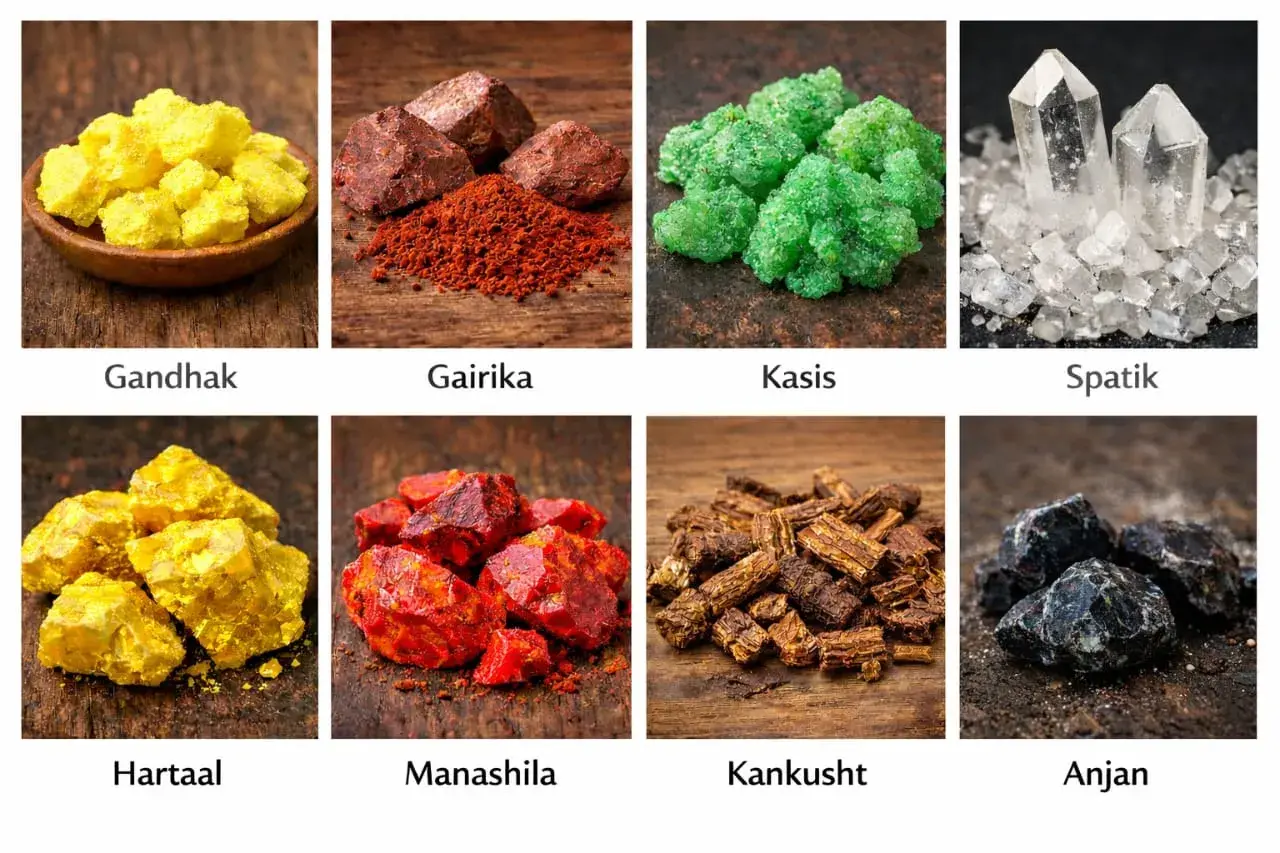
UPARASA

Name of Uparasa
1. Gandhaka
2. Gairika
3. Kasisa
4. Kankshi /sphatika
5. Haratala
6. Manhshila
7. Anjana
8. Kankushtha
1 Gandhaka / Sulphur
Vernacular name
Sanskrit Gandhaka
Hindi Gandhak
English Sulphur
Chemical formula S
Physical properties
Melting point 112℃ to 120 ℃
Boiling point 440℃
Hardness 1.5 to 2.5
Specific gravity 1.9-2.1
Appearance
Pita varna (yellow coloured) sukapiccha yellowish color.
Maniba krita (crystal form)
kathina Dravya (hard)
Snigdha (smooth)
Synonyms
AtiGandh, gouripushp, Gandhpashan, sogandhik, rasagandh, putigandh,
Bali, Navneet, keet-ghan, pamari, shulbari, Daityendr.
History
According to rasa-granthas 1st its origin was happened during smundarmanthana at ksheersagar along with amrita origin.
2nd thing its origin from menstrual blood of Devi Parvati (‘‘DEVYA RAJO BHVED GANDHO,,)
Origin places
Sulphur occure in its elemental forms specilly near the volcanic mountains and hot-springs.
Sicily (Italy), USA, Texas, Japan, Chile,
And it is also occurred in its compound form like sulphide and sulphate
Cinnabar /Red sulphide of mercury (hingula)
Calcium sulphate
Magnesium sulphate
Ferrous sulphate (kasisa)
Couper sulphate (sasyaka)
Iron pyrite (vimal)
Arsenic bisulphide/Realgar (mansheela)
Arsenic trisulphide/orpiment (hartal)
Zinc sulphide
Led sulphide
Apart from this it is also occur into plant origin like onion, garlic, radish, mustard seed etc.
Bhed /Varrietirs/ types
Ranarvkaar | Rsendrachudamani | Other /Aadhunik | |
1 | Rakta (uttam) | Rakta (dhatuvadnarth) Shuk-tund-nibham | Aamlasar gandhaka (internal) uttam |
2 | Pita (madhyam) | Pita (rsaynarth) Shuk-picch-nibhm | Khatika/pinda gandhaka madhyam |
3 | Sweta (adham) | Sweta (loh-marnarth) Khatika-kar |
|
4 |
| Krishna (jramrityu nashnarth) durlubh |
|
Shodhana of gandhaka
पयःस्वत्नो " घटीमात्रं वारिधौतो हि गन्यकः । गव्याज्य विह्रतो वखाद् गलितः शुब्धिमृच्छति ।। (र.र.स.३२०)
Procedure
1. Gandhaka is finely powdered in Mortar & pestle.
2. It is taken in the Goghrita stainless steel pan and heated over Angarkoshti.
3. The melted Gandhaka is filtered through a cloth into a vessel containing Godugdha.
4. Solid slab of Sulphur is obtained. It is then taken out, washed with hot water, dried & powdered.
Repeat this process 7 time to remove the impurities completely
And pale-yellow coloured gandhaka will obtain.
Pharmacological properties
Rasa - Katu, Tikta, Kashaya,
Guna- Ushna,
Karma Dipana, Pachana, Vishahara, Krimihara, Rasayana, Kaphavatahara.
Matra 120 mg-960 mg
Anupana Milk
Uses-Kandu, Kustha, Visarpa, Amadosha, Krimi, Pleeha
Pramukha yogas
Rasa Parpati Vijaybhairvrasa
Gandhak Druti Hansa Potali
Gandhak Rasayna Swarna Potali
Rasasindura Sobhagya Vati
Makardhwaja Trisunder Rasa
Jayamangal Rasa Kajjali
Gandhak Vati Punchamrita Parpati
Kankasundar Rasa Gandhak Taila
Laoh Parpati SmirPnnag Rasa
Pathya and apthya during gandhaka sevna
Pathya: godugdh (milk), goghrita(clearify butter), gehu (wheat), saindhva lavana (rock salt), mishri (rock/sugar candy), sheetal jala (normal water)
Apthya: Ati lavana (access salt), amala (sour), katu(spicy), patr saak (leafy vegitables)
2.Gairika/Ochre/Haematite
Vernacular name
Sanskrit Gairika:
Hindi Gairika/geru
English Ochre/Haematite
Chemical name ferric oxide (Fe2O3) Red oxide of Iron
Physical properties
Specific gravity 4.5 to 5
Hardness 5.5 to 6.5
Appearance
Red coloured muddy like material, some time it is in granular form and some time it is in crystal form.
Synonyms
Gaireya, Girimritika, Raktadhatu, Lohadhatu, Girimridbhav, Girija
History
Its use as chikitisa / therapeutic purposes occur in Samhita kala and it is explained into rasa-granthas too.
Origin
Maximum part of India like Bihar, Karnataka, Adhra Pradesh, Orissa
North America, Australia, Brazil, South Africa.
Bheda/varieties
R.Ch, RRS | Rasnarva | Ayurvedprakasha | |
1 | Pashana (kathin &tamar varna | Rakta | Swarna |
2 | Swarana ( snigdha, misran, Rakta varna | Hema | samanya |
3 |
| kewal | Pashana |
Significance term for Swarna Gairika
Its term Swarna added to this mineral is to indicate its brilliant red color
Or it’s used by goldsmith to making the gold shiny and bright.
Grahya swrupa /Acceptable variety
Deep Red coloured, soft, and smooth
Gairika shodhana
There are two methods of shodhana
1 acc. RRS
1. Convert the Gairika into fine powder.
2. Then triturate this churna into the kharla yantra by levigating it with milk.
3. After one bhavna of milk to gairika keep it for dry into sun light. Make sure its proper drying, otherwise due to milk fungus can grow. For reducing the chance of fungus growth proper drying is mandatory.
2. acc. A.P (Ayurved Prakasha)
1. Convert the Gairika into fine powder.
2. Then take 1/4th to 1/8th parts of cow’s ghee and roasted the powder of gairika into the low flame. And it will get purified.
Satvapatna
No need to its satwapatna according to acharya nandi
But acc. To prof. D.A Kulkarni iron may be obtained from its satva which would be greater than normal iron.
Pharmacological properties
Rasa Madhur, kshaya
Guna snigdha, sheeta
Virya sheeta
Karma chak-shushya, Rakt-stambhaka
Therapeutic uses
Rakt-pitta, hikka, vamana, visha vikara, kandu, udar roga,
Anaemia, menorrhagia, external use in the form of ointment promotes the wound healing.
Matra
2 to 4 ratti (250 to 500 mg)
Pramukh yogas
Irimedadi taila
Jatyadi taila
Pradantak loh
Jwarankushrasa
Somghrita
Gairikadhya taila
3.Kasisa/Green vitriol
Vernacular name
Sanskrit kasisam
Hindi kasis
English Green vitriol
Chemical name Ferrous Sulphate
Synonyms
Kashishak, kasis, pushp-kasis, panshuk, dhatukasis, khechar, khag
Physical properties
Hardness 2
Specific gravity 1.8-1.9
Appearance
It is a Hrit varna (green colour) mani-akriti (crystal type) material.
History
Its use mentioned in Charka Samhita as therapeutic use and in present time 100 above yogas are prevalent. And it was also used as an ink to write.
Origin
Bihar, Germany, Sweden, Spain, USA,
Moreover, it is artificially available.
Bheda/ types
Rasanarva (acc.varana) | Anand kanda (acc.varana) | Rasa jal nidhi (acc.varana) | Ayurved Prakash (acc.Rachana) | Rudrayamal tantra | |
1 | Shukala | Krishana | Pita (Pushpa kasisa) | Kasisa | Kasisa |
2 | Krishana | Pita | Sweta (balukasisa) | Dhatu kasisa | Pushpa kasisa |
3 | Pita | Sweta | Hrita (kritrim kasisa) | Pushpa kasisa | Heera kasisa |
4 |
| Rakta | Shyama (Dhatu kasisa) |
|
|
In RSS two varieties are mentioned baluka kasisa and pushpa kasisa.
In the local market it is available in the form of granular big green coloured pieces.
It is Baluka like granular, named as baluka kasis, also known as dhatu kasis or pashunkasis
In the open air it converts into yellow coloured powder known as pushap kasis
Shodhana
Ayurved Prakash and rasatarangini mentioned
By swedna method dipping of kasisa into bhringraja swarasa inside dolayantra . continue boiling for 3 prahar /9hr
Another method is levigation of kasisa with nimbu swarasa for 1 and dry it into sulight.
Marna
Purified kasisa is powdered and triturate with the juice of leaves of snuhi
(Euphorbia Nerifolia) for 7 times. Then Chakrikas are prepared and dried.
And sealed into the srawsamputa, after that subjected to laghuputa. This procedure continued till kasisa loses its acid nature. then red coloured Bhasma will obtain.
Satvapatana
By triturating with kshara and amliya drvya and give the tivra agni
Pharmacological action
Rasa amla, kshaya
Guna snigdha
Virya ushna
Karma balya, netrya, keseranjana, artavanjana vataslesmhara
Matra: 60 to 240 mg / 1/2 ratti to 2 ratti
Anupana
Honey and ghrit
Therapeutic indications
Pandu, pliha roga, kandu, mutrakrcha, Asmari
Pramukha yoga
Kasisadi gutika
Kasisadhya taila
Rajapravartani vati
Loha rasayna
4.Kankshi/Alum
Vernacular name
Sanskrit Sphatika, kankshi
Hindi phitkari
English Alum, potashalum
Chemical name K2SO4 Al2(SO4) 24H2O (aluminium potassium Sulphate Dodeca-hydrate)
Synonyms
Sourashtri, tuvari, Shubhra, Rangda, pitika, sphatikari, phatika.
Physical properties
Specific gravity 1.75- 2.6
Hardness 3.4 to 5
Melting point 92 degree calcious
Appearance
Alum is a white crystalline solid having an astringent taste. It is readily soluble in water.
History
In charka Samhita and rasa granthas mentioned about kankshi.
Origin
The main source of Alum in India is Sourarashtra and other sources are Punjab,bihar,goa,uttar Pradesh
Bheda/ types
Rasnarva | Rsenderchudamani | Rasaratnsmuchya | |
1 | sit(khandatmika) | Ishtpeet (guru, snigdha, sphatika | Phataki (ishtpeet) |
2 | Krishan (churna rupa) | Shubhra varna (nirbhar/light weighted, snigdh, samal, phullika | Phullika (Shubhra varna) |
Grahya /acceptable variety:
Ishpeet varna, bharyukta, snigdha, this is the best for rognashaka .
Shodhana
By soaking of alum into small quantity of kanji/gruel for 3 days after three days it becomes shudha.
Take coarse powder of the alum into earthen or iron griddle /wok. now place the alum containing wok or griddle over the heat. Give the heat till whole water part of alum evaporated. At the end light weighted white coloured material will appear that is shudha alum.
Marna
Enclose the alum into shravsamputa and give the one agni of laghuputa
Maran will complete and white coloured bhsma will obtain.
Satvapatana
By triturating with kshara and amliya drvya and give the tivra agni
Matra/Dose 2 to 5 ratti (240mg to 480mg)
Anupaan sarkara
Pharmacological actions
Rasa kasahya, amla, madura
Guna guru,snigdha
Virya ushana
Karma vranaroya, grahi, keshya, kanthya
Therapeutic indications
Raktastambhak, mukharognashka, netra roga, vishghana, kushthhara
Pramukh yogas / formulations
Eladi mantha
Garuda-anjana
Chatuh-sudharasa
Visakalpa
Dravkorasa
Visakalpa
Shankha-drava
5.Haratal/Orpiment
Vernacular name
Sanskrit haritalam
Hindi hartal
English orpiment/ Arsenical gold/yellow arsenic
Chemical name/formula AS2S3 trisulphide of Arsenic
Synonyms
Taal, vidalaka, hritala, chitr-gandhaka, talaka, nat-mandaka, shail-bhushnam, vansh-patraka
Physical properties
Specific gravity 3.5
Hardness 1.5 to 2
Melting point 300 to 325 degree calcious
Appearance
Bright Yellow coloured, soft and crystalline material which possess the mass
History
In charka Samhita, Sushrut samhita and rasa granthas mentioned about haratala
Origin
Artificially and originally occurs. Along with realgar mines it occurs too.
USA, Peru, Hungry, Italy, iran
In India, it is found in small quantity at kashmir and darjling
Bheda/ types
Patra-haratala (uttum)
Pinda-haratala (adhum)
Patra-haratala (uttum)
It contains the layers and it is brightening yellow coloured, heavy and useful for rasayna karma
Pinda-haratala (adhum)
The pinda haratala is massive and without layers has less potency. It has lesser qualities than patra hartala.
Grahya /acceptable variety;
patra haratala is the grahya swrupa of hartala
Shodhana
Kushmand swarasa, tilkshara jala, churnodka, nimbuswarasa and kanji
Take any liquid from mentioned above and boil the haratala for 3 hrs in dolayantra.
Marna
Take equal quantity of Shudha hartal powder and mukta bhusma into the khalva yntra
then levigate this mixture with kumari swarasa.
Further make the Chakrika and enclose it into srava samputa , after that subject it into laghuputa agni
Matra/Dose
1/4th to ½ ratti
Anupaan
Gduchi Kashaya, honey, grita
Pharmacological actions
Rasa katu, tikta, kshaya
Guna snigdha, guru
Virya ushna
Karma Sleshmaroga hara, Saktadosha hara,Vatahara,Vishahara
Therapeutic indications
Raktapitta, vata roga, rakta kushtha ,kandu, dadru, pama, jwara,
Pramukh yogas / formulations
Kasturibhairva rasa
Talkeshwar rasa
Talsindura
Smirpnnag rasa
6.Manshila/Realgar
Vernacular name
Sanskrit manhshila
Hindi mainshila
English Realgar
Chemical name AS2S2 disulphide of Arsenic
Synonyms
Roga-shila, Shila, nepalika, rasa-netrika, mnogupta, naga-mata
Physical properties
Specific gravity 1.4 to 2
Hardness 3.5
Melting point 308 to 320 degree calcious
Appearance
It is red to orange yellow coloured substance, shiny and slightly heavy
History
In charka Samhita and rasa granthas mentioned about manshila.
Origin
China, spain, Greece, india (kumaun hill ranges /uttrakhand)
Bheda/ types
3 bheda of manshila
Types | significance |
Shyamangi Shrestha Uttam
| It is light black, red, yellowish white and heavy (acc. To A.P red like hungul with yellow tinge) |
Kanvirka Shreshtar Madhyam
| Bright, slightly gour varna and tamra varna yukta (acc. To A.P red coloured an available in powder form) |
Khandakhya Sarvshreshter Adham
| deep red in colour having weight (slightly red and yellow tinge) |
Grahya /acceptable variety;
Shyamangi is the best variety to be use.
Shodhana
Agtsya patra swarasa 7 bhavna
Bijaora nimbu swarasa 7 bhavna
By dipping of manashila for 3 days into Chuna yukta jala
Satvapatana
1 part of manshila, 1/8th parts of mandura,guda,guggul,ghrita ground well. then take this mixture into the musha and place into tivragni. And arsenic as a satwa will obtain.
Matra/Dose
15 to 30 mg
Pharmacological actions
Rasa tikta, katu
Guna snigdha,ushna,guru
Virya ushna
Karma rasayna, lekhniya, vishagna
Therapeutic indications
Swasa, Kasa, Jwara, Kadu, Kustha and agnimandya.
Pramukh yogas / formulations
Swaskuthar rasa
Trilokyachintamani rasa
Rasraja rasa
Kshyakesri rasa
Manshiladi dhum
7.Kankustha/Ruhbarb
Vernacular name
Sanskrit Kankustham
Hindi Kankusth
English Ruhbarb
Chemical name/ Botanical name Garcinia Morella
Synonyms Kolbaluka, Kakakankustha, Taalkustha, Rangdayaka,
Kechaka, Vrang, Virang, Swarnkshiriniryasa, Hemvati.
Appearance
It is a rasin of the tree reddish to yellow coloured odourless
History
It is a sandigdha drvya (controversial),
For example:
Acc To. |
|
Dalhana | It is swarnkshiri and its niryas (varity of poppy plant) |
Rasnarva | It is kind of pravala |
RRS | It is a special substance produced on the peaks and mountain ranges of the himalyas. |
| Faeces of new born baby elephant, or umbilical cord of newly born hourse. |
Vdh. pandit Shaligram shastri | It is mridar-shring
|
Yadav ji | It is a concentrated extract of the root of Gambose tree |
Origin
Native of Himalayan region
Bheda/ types
Two types
Nallika kankustha | Yellow coloured, shiny,heavy, snigdha |
Renuka kankustha | Blackish- yellow,light weighted, |
Grahya /acceptable variety; nallika kankustha
Shodhana: by giving the bhavana with sunthi decoction
Matra/Dose 1/4th ratti (30 mg)
Anupaan shunthi , jeerka, gajpippli
Antidot use the babul mool kwatha and jeera or tankana prakshepa in equal quanty
Pharmacological actions
Rasa tikta, kshaya
Guna ushna and tikshana
Virya ushna
Karma Atirechana (drastic purgative)
Therapeutic indications
Arsha, vrana, pliharoga, Udavartha.
Pramukh yogas / formulations
Dhanvantri ghrita
Dhanvantri rasa
Shothodrari rasa
Mritsanjivani rasa
Udvarthara grita
Jyotishman rasa
8.ANJANA
Vernacular name
Sanskrita anjanam
Hindi Anjana
English collyrium
Synonyms /paryaya
Mechaka
Lochaka
History
In charaka Samhita and sushruta Samhita it is popular with name
Anjana,strotoanjana, soviranjan,rasanjan,pushpanjan
Origin/praptisthana /Utpatti
Acc. To Rasa-kamdhenu its origin from mountains and rivers.
In present time its origin as natural form and artificially both are occurring.
Bheda ( rasendra chudamani, R.R.S)
1. srotoanjana, (Dhumra,pandu and sweta varna)
2. soviranjan, (bluish red)
3. rasanjan, (pita varna)
4. Pushpanjan (sweta varna)
5. Nilanjana (neel varna
Srotoanjana and soviryanjana
Both types having same chemical composition. both are stibnite (Sb)or antimony trisulphide Sb2S3. And another significance features are also same.
Both are antimony’s ores (sulphide of antimony)
Srotoanjana is available in the form of ant-hill. The broken surface has the tinge of blue. If it is rubbed, leaves the reddish marks. Resemble the gairika colour.
Paryaya
Strotaj, yamuneya,yamun
Soviryanjana is said to be it is a variety of srotoanana, only colour and physical properties are described. It is sweta, Dhumra, or pandu varna.
Paryaya
Souvira, suviraja, krishnanjana, kalanjana.
Stibnite
Physical properties/appearance
Colour Gray with blue tinge also silvery white
Shape Crystal form pyramidical terminals
Hardness 2
Specific gravity 4.5 to 4.6
Streak Gray
According to classical text streak is mentioned Garika sadrisha, but in actual it is Gray.
Origin: UK, USA, North America, France, China, Japan
In India Bihar, A.P, Punjab.
Shodhana
Both the Anjanas are shoudhita by the swedna vidhi by using the triphala kwatha and bhringraja juice.
Pharmacological actions
Both Srotoanjana and soviryanjana having same gunas.
Rasa Madhura, Kashaya
Guna snigdha
Virya shita
Karma Tridoshghana , lekhniya, netrya, grahi,keshya.
Therapeutic indications
Visharoga, karnaroga,vaman, hikka,raktpita.
Nilanjana
It is containing 81.6% lead and 13.4 Sulphur.
Vernacular name
Sanskrit pushpanjanam
Hindi pushpanjan
English Galena
Chemical name Lead sulphide PbS
Synonyms Shakarbhumij, Suvarnghana, Loham-ardavkara
Physical properties/appearance
Colour led Gray with blue tinge.
Shape Cubic Crystal
Hardness 2.5
Specific gravity 7.4 to 7S.6
Streak lead Gray
Origin: Mayanmar, USA, Australia,UK
In India Bihar, A.P, Punjab,J&K,Tamilnadu,Rajsthan
Shodhana
The powder of Nilanjana is levigate by the jambiri nimbu swarasa & dried under the sun for whole day.
Pharmacological actions
Rasa Madhura, Kashaya
Guna guru, snigdha
Virya shita
Karma Tridoshhara , rasayana, netrya,
It is useful for the marna of the metals
Pushpanjana
Vernacular name
Sanskrit pushpanjanam
Hindi pushpanjan
English zinc white
Chemical name zinc oxide
Synonyms kusumanjan, pushpaketu, ritipushpaka, koustubha, ritija
Physical properties
Melting point 419 to 930 degree calcious
History
It is a controversial Dravya.
Acc. To charka:
as its name indicates it is derived from the pushpa that’s why it is pushpanjanam.
Acc. To RRS
It is white in colour and useful for the netra-chikitsa
Acc.atreya samhita
Pushpakasis also called nnayan-aushdham which indicating its use on eye diseases.and also its appearance resembles as pushpanjanam.
Ayurved prakasha
Ritti-kitta is pushpanjana riti is pittal (brass) it is alloy of Cu and Zn.
Some copper compounds like copper sulphates are useful to eye diseases
And zinc is directly related to pushpanjana.
Potash alum might be pushpanjanam after shodhana having white coloured appearance and also useful for netra chikitsa
Shiddhinandan Mishra
As a matter of fact, zinc oxide is available naturally which is called zincite,
However, it is considered as Rasaka
Shodhana
no specific shodhana mentioned hence general shodhan method can use bhavna with bhringraja swarsa
Pharmacological actions
Rasa lavan
Guna snigdha
Virya shita
Karma all types of netr rogas, hikka, vishajanya roga
Rasanjana
Vernacular name
Sanskrit Rasanjanam
Hindi rasanjana
Synonyms rasa-garbham,raso-udbhava, takshrya, balbhishja,
taksharya-shialum
present time: it is the concentrated kwatha of Daruhridra kashtha
preparation (ayurved prakasha)
take equal quantity of each ingredient daruhridra kwatha , godugdha or aja dugdha now paka of this liquid till 1/4th left.
History
Considered as controversial due to its pryaya (R.T)
Rasa word is use in its name so it should be related with parda compounds
Compound which forms after Dhaman of ritti (pittal) that is rasanjana
Shailja (obtained naturally from the mines)
Kritrim : pitchandna kwathaja or niryasaja
Origin
Utrakhand, Himachal pradesh
Shodhana
By bhavna of each Dravya’s swarasa of suryavarti yoga (suryavartaka, kadali, koshataki, shugru,nirkana, bandhya, bajar kanda, kakmachi) it will become shudha
Pharmacological actions
Rasa Madhur, tikta, katu
Guna shita
Virya shita
vipaka madhura
Karma swasa roga , vatrakta , and netra roga
Pramukha yoga of Anjana
Pushya-nuga churna
Piyushvalli
Pannag-asava
Chandanadi churna